-
Reading time : 4 min.
-
Source code : github.com/bcuzbroa/ZeroCostGame
Disclaimer
If you want to try the game before reading the article, find it here : ctfd.bcuzbroa.fr
Motivation
Some features of Rust are often described as a “zero-cost abstraction” (especially iterators). To make the learning journey more interactive, I developed ZeroCostGame, a Capture The Flag inspired project designed to teach Rust through puzzles and automated validation.
What is the ZeroCostGame?
ZeroCostGame is a collection of coding challenges where the player must implement specific logic to “win” a flag. It uses a black-box Oracle to wrap and test your code. The Oracle reveals the flag if your implementation is correct.
The project is structured as a Rust Workspace:
challenges/: Your playground. This is where you write your solutions.oracle/: The “Black Box” containing encrypted flags and validation logic.
Under the hood:
This section shows how the oracle works in the game
Creating the challenge
First of all, to create a challenge I need to write a function that I find interesting to develop and think about for the player’s Rust journey. Then, I needed a structure to store the challenge information, the future key, the tests and the logic associated to it. The following trait is therefore defined in logic.rs:
pub trait ChallengeVerifier {

    type Output : AsRef<[u8]>; //This type can be hashed

    fn id() -> &'static str;

    fn run_code(path : &str) -> Self::Output;

    fn check_code(path: &str) -> bool;

    // Default implementation for compilation purposes
    // &[0] is later replaced with the encrypted flag
    fn secret_data() -> &'static [u8]{&[0]}

    fn run_external(path: &str, wrapper_main: &str) -> String {
        wrapper(path, wrapper_main, Self::id())
    }
}
This trait is implemented for each challenge in separate files.
To create the encrypted flag, let’s say FLAG{my_blog}, I implemented the encryp_flag.rs module in oracle\bin\. The encryption uses the awesome XChaCha20Poly1305 algorithm with a key derived from the run_code output method !
The module generates the ciphertext which is later stored in secret_data. Our trait is now fully implemented, lets give the challenge a try !
Player Experience
Initially, a challenge is just a .rs file implemented by the player. I needed a structure to store the challenge information, the key, the tests and the logic associated with it. The following trait is thus defined in logic.rs:
In the ChallengeVerifier trait, the run_external function wraps the player code and executes its implemented function (while ignoring its main using some extraordinary regex to do so). The wrapper compiles the code then executes it with the values of our choice. This allows the system to determine if the player respected the challenge or not.
Ok now, we can run the player code, the check_code function tests the code.
If check_code returns true, then the code is run with a specific input to later build the key that should be the correct one, as the tests passed. The flag is then decrypted with decrypt.rs:
use chacha20poly1305::{
    aead::{Aead, KeyInit},
    XChaCha20Poly1305,
};


pub fn decrypt(
    key: &[u8; 32],
    nonce: &[u8; 24],
    cipher: &[u8],
) -> Option<Vec<u8>> {
    let cipher_algo = XChaCha20Poly1305::new(key.into());
    cipher_algo.decrypt(nonce.into(), cipher).ok()
}
the decrypt function is called by the solve function which is defined for any type V that implements the trait ChallengeVerifier suchs as :
pub fn solve<V : ChallengeVerifier>(path: &str) -> Option<String>{
    if !V::check_code(path){
        println!("Tests not passed.");
        return None
    }
    let out = V::run_code(path);
    let key = blake3::hash(out.as_ref());
    let nonce = [0x42u8; 24]; //Static
    let cipher = V::secret_data();
    let decrypted = crypto::decrypt(key.as_bytes(), &nonce, cipher)?;
    let d_flag = String::from_utf8(decrypted).ok();
    d_flag
}
Here is where the tests are passed and the function decrypts the flag.
Testing the player code
As the player code comes from external files, having oracle’s point of view, I decided to test its code using the wrapper. Let’s take a look at challenge3’s tests:
fn check_code(path: &str) -> bool {
    let test_wrapper = r#"
        fn main() {
            let t1 = value_or_zero(Some(10)) == 10 && value_or_zero(None) == 0;

            let list = vec![Some(5), None, Some(15), None];
            let sum = sum_options(list);

            let empty_sum = sum_options(vec![]);

            let t2 = sum == 20;
            let t3 = empty_sum == 0;

            print!("{}", t1 && t2 && t3 );
        }
    "#;
    Self::run_external(path, test_wrapper) == "true"
}
This function takes part in the ChallengeVerifier trait implementation. The tests are directly written in a main function that will then be replaced with the original player’s main. Then the print!() will print either false or true depending on tests results
The main.rs file finally organizes the overall challenge:
fn main() {

    let args= Args::parse();

    let path = &args.path;

    // Verify the directory exists before proceeding
    if !std::path::Path::new(&path).exists() {
        println!("Error: The challenge path: '{}' does not exist.", path);
        return;
    }

    let re = Regex::new(r"(\d+)").unwrap();

    let challenge_id = re.captures(path)
        .and_then(|cap| cap.get(1))
        .map(|m| m.as_str())
        .unwrap();

    match challenge_id {
        "0" => run_challenge::<Verifier0>("Sanity Check"    , path),
        "1" => run_challenge::<Verifier1>("Ownership"       , path),
        [...]
        "10" => run_challenge::<Verifier10>("Generic Master" , path),

        _ => println!("Challenge{} does not exist yet or is not implemented", challenge_id)
    }
}

fn run_challenge<V: ChallengeVerifier>(name: &str, path: &str){
    match solve::<V>(path){ //TURBOFISH
        Some(flag) => println!("{}\n✨ {} ✨ verified: {}", banner(), name, flag),
        None  => println!("❌❌ {}: NOPE ❌❌ Do you even try ??", name)
    }
}
The overall challenge flow is as follow:
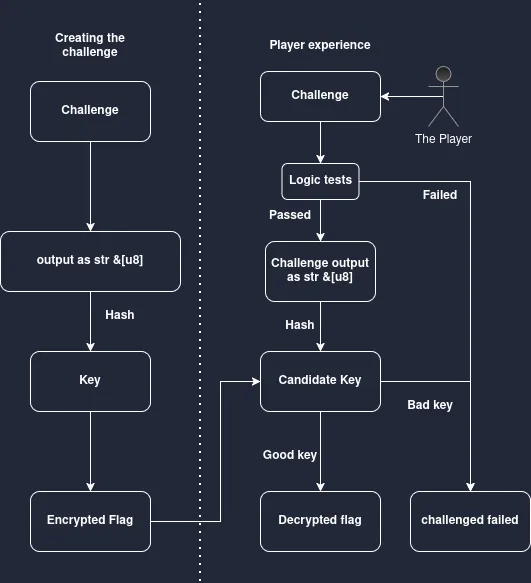 I create the challenge then generate the encrypted flag. When the player plays, if its code passes the tests, the flag is decrypted using the key generated by the tests. (The key is derived from the Challenge output).
Note & huge cashprize
I will give $5 to the first person that pwns the oracle. By this I mean, find a way to retrieve the flags without doing the challenges. I guess it is possible to reverse it but I’m not yet used to reversing complex rust projects. Contact me if you manage to crack it.

Thank you for reading !